What Is Blockchain Technology? 99% Less Energy & Secure Ledger
What Is Blockchain Technology? 99% Less Energy & Secure Ledger

Many assume blockchain equals Bitcoin and offers complete anonymity. Reality check: 70% of Bitcoin transactions have identifiable patterns linked to real actors. Blockchain is a diverse ecosystem with various types consuming vastly different energy levels. This guide clarifies blockchain fundamentals, consensus mechanisms, and practical applications to help you manage crypto portfolios confidently.
Table of Contents
- Understanding Blockchain Fundamentals
- Consensus Mechanisms and Security
- Comparison of Blockchain Types: Public, Private, and Consortium
- Real-World Use Cases of Blockchain Beyond Cryptocurrency
- Effective Digital Asset Portfolio Management with Blockchain Tools
- Common Misconceptions about Blockchain Technology
- Bridging Understanding to Practical Application Using Solaria World
- Manage Your Crypto Portfolio Securely with Solaria World
Key Takeaways
| Point | Details |
|---|---|
| Decentralized Ledger | Blockchain distributes transaction records across thousands of nodes worldwide, eliminating single points of failure. |
| Consensus Secures Network | Proof of Work and Proof of Stake validate transactions without central authority, with PoS cutting energy use by 99%. |
| Multiple Blockchain Types | Public blockchains prioritize transparency, private ones speed, and consortium models balance both for enterprise needs. |
| Portfolio Tools Simplify Management | Integrated platforms aggregate exchanges, automate tax compliance, and secure assets through vault services. |
| Transparency Over Anonymity | Blockchain transactions are traceable through public ledgers, not fully anonymous as commonly believed. |
Understanding Blockchain Fundamentals
Blockchain functions as a decentralized digital ledger where every participant maintains a synchronized copy. Think of it as a shared spreadsheet that thousands of computers update simultaneously. When you initiate a crypto transaction, that data gets grouped with others into a block.
Each block connects to the previous one through cryptographic hashing, creating an unbreakable chain. Altering any past transaction would require changing every subsequent block across thousands of computers simultaneously, making fraud practically impossible. This architecture removes the need for banks or payment processors to verify transactions.
Distributed nodes maintain the network by:
- Storing complete copies of the transaction history
- Validating new transactions against blockchain rules
- Broadcasting verified blocks to other network participants
- Reaching agreement on the current state of the ledger
The security benefit stems from redundancy and decentralization. Consensus is maintained by thousands of nodes worldwide, preventing single points of failure. If one node goes offline or attempts fraud, the remaining network continues operating normally. For beginners seeking deeper knowledge, blockchain learning resources for beginners offer structured educational paths. Understanding these blockchain technology basics provides the foundation for evaluating different cryptocurrencies and platforms.
Consensus Mechanisms and Security
Consensus mechanisms solve a critical problem: how do strangers validate transactions without trusting each other or a central authority? These protocols establish agreement across distributed networks, ensuring only legitimate transactions get added to the blockchain.
Proof of Work requires miners to solve complex mathematical puzzles before adding blocks. Bitcoin uses this method, where specialized computers compete to find the solution first. The winner earns newly minted coins plus transaction fees. This approach secures the network through computational difficulty, but demands massive electricity consumption. Mining farms consume as much power as small countries, raising environmental concerns.
Proof of Stake takes a different approach by selecting validators based on how many tokens they hold and commit to the network. Ethereum switched to this model in 2022, and Proof of Stake blockchains reduce energy consumption by over 99% compared to Proof of Work. Validators risk losing their staked tokens if they approve fraudulent transactions, creating financial incentive for honesty.
Key differences between consensus models:
- Energy efficiency: PoS eliminates the race to solve puzzles, slashing electricity needs
- Hardware requirements: PoW demands specialized mining equipment, while PoS runs on standard computers
- Decentralization concerns: PoW concentrates power in mining pools, PoS in large token holders
- Transaction speed: PoS generally processes transactions faster without computational delays
Pro Tip: When evaluating cryptocurrencies for investment, check their consensus mechanism. PoS coins often have lower environmental impact and higher transaction throughput, while PoW coins may offer greater proven security through longer operational history.
These mechanisms directly impact network security and trustworthiness. The higher the cost to attack a network (whether computational power or staked capital), the more secure it becomes. Understanding blockchain security features explained helps you assess risk when choosing where to store assets.
Comparison of Blockchain Types: Public, Private, and Consortium
Not all blockchains operate identically. The level of access control and decentralization creates distinct categories, each suited for different applications.
| Feature | Public Blockchain | Private Blockchain | Consortium Blockchain |
|---|---|---|---|
| Access | Anyone can join | Invitation only | Limited validator group |
| Decentralization | Fully distributed | Centralized control | Semi-decentralized |
| Speed | ~7 transactions/second | Thousands per second | Hundreds per second |
| Transparency | Complete public visibility | Restricted viewing | Shared among members |
| Use Cases | Cryptocurrency, DeFi | Enterprise operations | Industry collaboration |
Public blockchains offer transparency and decentralization but have lower throughput. Bitcoin and Ethereum exemplify this model, where anyone can read the ledger, submit transactions, and potentially become a validator. This openness ensures no single entity controls the network, but processing speed suffers as consensus requires coordination across thousands of nodes.

Private blockchains sacrifice decentralization for performance. A single organization controls who participates and validates transactions. Banks use private blockchains for internal settlements, processing thousands of transactions per second. The tradeoff? You must trust the controlling entity, somewhat defeating blockchain’s core purpose.
Consortium blockchains split the difference. A predetermined group of organizations jointly manages the network. Supply chain collaborations often use this model, where manufacturers, shippers, and retailers share transaction data while excluding competitors. This provides:
- Better performance than public chains through limited validators
- More decentralization than private chains by distributing control
- Selective transparency among trusted partners
- Reduced costs compared to maintaining separate systems
Your investment choices should align with these distinctions. Public blockchain tokens offer true decentralization but face scalability challenges. Private blockchain projects may deliver efficiency but lack the trustless verification that makes blockchain revolutionary. Learning about different blockchain types explained helps you evaluate projects critically.
Real-World Use Cases of Blockchain Beyond Cryptocurrency
Blockchain technology extends far beyond digital money. Smart contracts on Ethereum transformed blockchain from a payment system into a programmable platform.
Ethereum supports over 3,000 active decentralized apps processing billions monthly. These applications automate complex agreements without intermediaries. Decentralized finance platforms let you lend, borrow, and trade assets without banks. NFT marketplaces use smart contracts to verify digital ownership and automate royalty payments to creators.
Cross-border payments showcase blockchain’s efficiency gains. Traditional international transfers take days and cost $20 to $50 in fees as money passes through correspondent banks. Blockchain settles these transactions in minutes for under $1. Migrant workers sending money home save hundreds annually by avoiding traditional remittance services.
Enterprises adopt blockchain for collaboration and transparency:
- Walmart tracks food from farm to shelf, reducing contamination investigation time from weeks to seconds
- Maersk and IBM created TradeLens to digitize shipping documentation, cutting paperwork costs by 40%
- Financial institutions use Hyperledger for trade finance, replacing weeks of manual verification with instant settlement
- Healthcare networks share patient records securely while maintaining privacy through permissioned access
These applications share common benefits: reduced intermediaries, automated verification, and immutable audit trails. Whether tracking diamonds to prevent conflict minerals or verifying academic credentials, blockchain provides trusted records without central gatekeepers. Exploring enterprise blockchain examples reveals how industries adapt this technology. The blockchain use cases continue expanding as developers discover new applications.
Effective Digital Asset Portfolio Management with Blockchain Tools
Managing crypto across multiple exchanges creates complexity. You check Coinbase for Bitcoin, Binance for altcoins, and a hardware wallet for long-term holdings. Each platform requires separate logins, fee structures, and tax reporting. Portfolio aggregation tools solve this fragmentation.
These platforms connect to your exchange accounts via API, pulling transaction history and current balances into unified dashboards. You see total portfolio value, asset allocation, and performance metrics in one place. Benefits include:
- Error reduction through automated data collection versus manual spreadsheet entry
- Real-time tracking of holdings across unlimited exchanges and wallets
- Consolidated reporting for tax preparation and regulatory compliance
- Historical performance analysis to identify profitable strategies
Tax automation features save hours during filing season. The IRS treats each crypto trade as a taxable event, requiring calculation of gains or losses. Manual tracking becomes impossible with hundreds of transactions. Advanced platforms automatically calculate cost basis using methods like FIFO or specific identification, generate necessary tax forms, and identify loss harvesting opportunities to offset gains.
Pro Tip: Enable API read-only access when connecting exchanges to portfolio tools. This lets the platform view your transactions without permission to trade or withdraw funds, maintaining security while enabling automation.
Security remains paramount when consolidating access. Vault services provide institutional-grade protection for long-term holdings. These segregate assets from exchange hot wallets, requiring multiple authentication factors for withdrawals. Cold storage combined with insurance policies protects against both hacks and operational failures.
These tools empower investors at all levels. Beginners gain clarity on portfolio composition without mastering multiple platforms. Advanced traders access sophisticated analytics for strategy optimization. Learning about managing crypto exchanges effectively and implementing crypto tax compliance tips becomes simpler with integrated solutions. For those building knowledge systematically, crypto portfolio management education provides structured learning paths.
Common Misconceptions about Blockchain Technology
Myths about blockchain persist despite growing adoption. Clearing these misunderstandings helps you make informed decisions.
Blockchain does not guarantee anonymity. Public ledgers record every transaction permanently. While addresses appear as random strings, analysis tools trace patterns. Exchanges following KYC regulations link addresses to real identities. Privacy coins like Monero add obfuscation, but most major cryptocurrencies offer pseudonymity at best, not anonymity.
Blockchain is not synonymous with Bitcoin. Bitcoin pioneered the technology, but thousands of blockchains now exist. Ethereum enables smart contracts, Cardano focuses on sustainability, and Solana prioritizes speed. Each blockchain makes different technical tradeoffs. Equating all blockchain projects with Bitcoin ignores vast diversity in design and purpose.
Not all blockchains share identical performance characteristics:
- Bitcoin processes about 7 transactions per second
- Ethereum handles roughly 15 to 30 depending on network congestion
- Solana claims capacity exceeding 50,000 transactions per second
- Visa processes around 1,700 transactions per second for comparison
Scalability varies dramatically based on consensus mechanism, block size, and network architecture. Blanket statements about blockchain speed ignore these technical nuances. Some sacrifice decentralization for throughput, others prioritize security over performance.
Understanding these realities prevents disappointment and poor investment choices. Expecting complete privacy on Bitcoin leads to security mistakes. Assuming all blockchains scale like payment networks creates unrealistic performance expectations. Reviewing blockchain misconceptions clarified builds accurate mental models of what blockchain can and cannot do.
Bridging Understanding to Practical Application Using Solaria World
Theoretical blockchain knowledge becomes valuable when applied to real portfolio management. Platforms like Solaria World translate these concepts into practical tools.
The platform integrates exchange accounts and wallets into a unified interface. Instead of logging into five different sites to check balances, you access everything through one dashboard. This aggregation uses blockchain data directly, pulling transaction records from public ledgers and exchange APIs. You maintain control of private keys while gaining visibility.
Vault services implement blockchain security principles for asset protection:
- Multi-signature requirements prevent unauthorized withdrawals
- Cold storage keeps private keys offline, immune to remote attacks
- Diversified custody across secure facilities reduces single points of failure
- Insurance policies cover potential losses from operational issues
Automation handles tedious compliance tasks. The system tracks every transaction across connected accounts, calculates cost basis, and identifies tax loss harvesting opportunities. When Bitcoin drops, the platform flags potential sales to offset gains elsewhere. Come tax season, you download completed forms rather than reconstructing transaction history manually.
User interfaces accommodate different skill levels. Beginners see simplified views focused on total value and basic allocation. Advanced users access detailed analytics, performance attribution, and strategy backtesting. Both benefit from blockchain’s transparent record keeping without mastering the underlying technology.
Adopting these solutions streamlines crypto management significantly. You spend less time on administrative tasks and more on investment decisions. Getting started involves connecting existing accounts, reviewing security settings, and exploring available features. Resources like getting started with Solaria World walk through initial setup. The SolariaControl multi-exchange platform demonstrates integrated trading and portfolio management in action.
Manage Your Crypto Portfolio Securely with Solaria World
Understanding blockchain technology empowers better investment decisions, but managing multiple crypto holdings still requires robust tools. Solaria World addresses this by aggregating exchanges, providing vault security, and automating tax compliance.
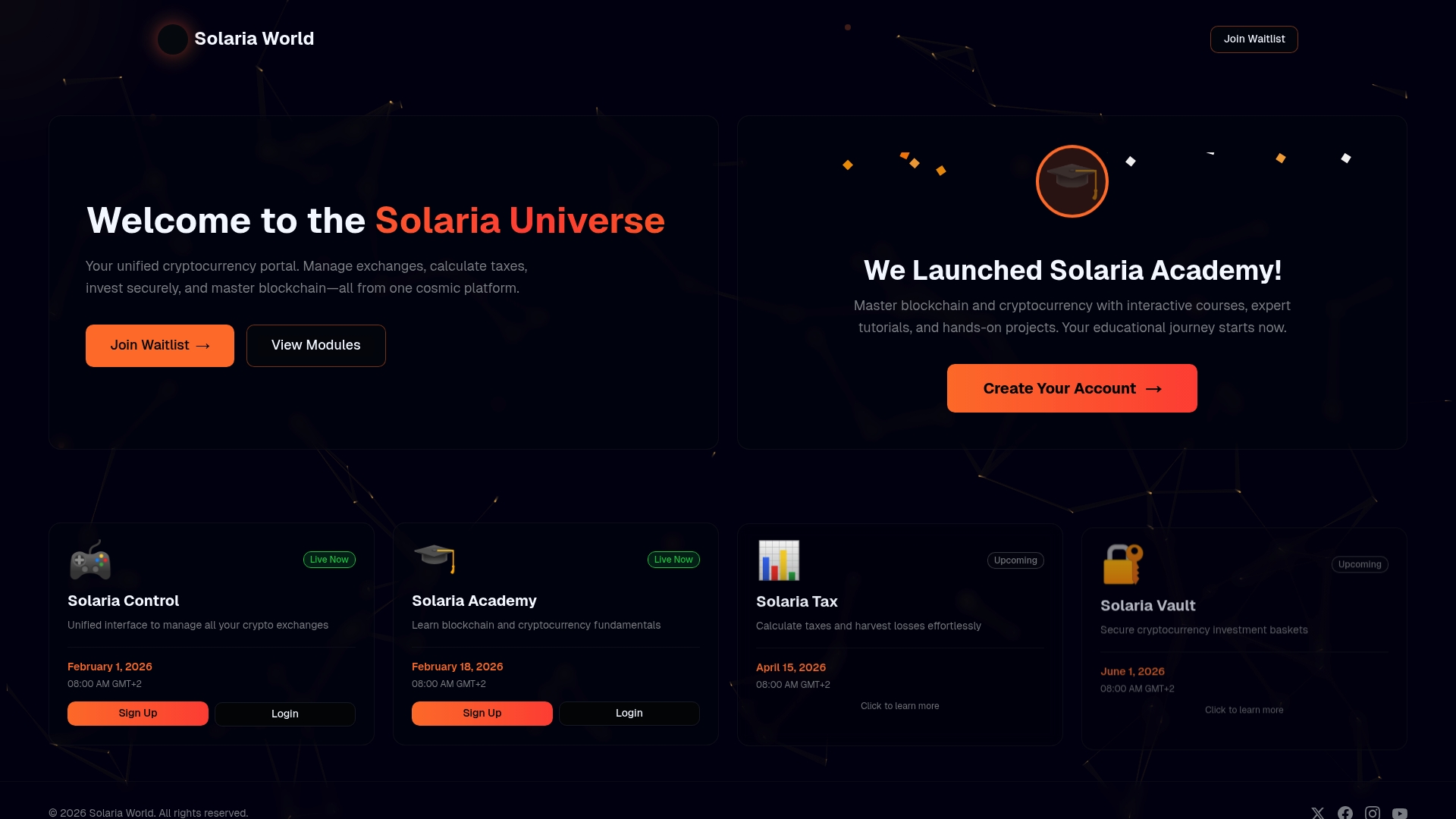
Our platform consolidates your Bitcoin, Ethereum, and altcoin positions across unlimited exchanges into one dashboard. Real-time tracking eliminates manual updates. Vault services protect long-term holdings with institutional-grade security while automated tax tools handle compliance calculations. Whether you’re starting your crypto journey or optimizing an established portfolio, Solaria World simplifies complex blockchain-based asset management. Explore our guides on managing crypto exchanges successfully and mastering crypto tax compliance. Ready to streamline your crypto experience? Visit SolariaControl to begin unified multi-exchange trading today.
What Is Blockchain Technology? Frequently Asked Questions
How does blockchain differ from traditional databases?
Blockchains distribute data across thousands of independent nodes rather than storing it in one location controlled by a single entity. Each participant maintains a complete copy, and consensus mechanisms validate changes collectively. Traditional databases centralize control, allowing administrators to modify records unilaterally.
Why is blockchain considered secure for cryptocurrency transactions?
Cryptographic hashing links each block to its predecessor, making historical tampering detectable immediately. Consensus mechanisms require majority agreement before adding new blocks, preventing fraudulent transactions. The distributed architecture eliminates single points of failure that hackers typically exploit in centralized systems.
Can blockchain really be traced despite claims of anonymity?
Yes, public blockchains record every transaction permanently on visible ledgers. While addresses appear as random strings, analysis tools identify spending patterns and link addresses together. Exchange KYC requirements connect these addresses to real identities, making most blockchain activity traceable rather than truly anonymous.
How do portfolio management platforms use blockchain data?
These platforms connect to blockchain networks through APIs and nodes, reading transaction records directly from public ledgers. They match your wallet addresses and exchange accounts to relevant transactions, aggregating holdings and calculating performance automatically. This provides real-time accuracy without manual data entry.
What consensus mechanism should I look for in crypto investments?
Proof of Stake generally offers lower energy consumption and faster transactions compared to Proof of Work, making it preferable for environmental and performance reasons. However, Proof of Work has longer operational history and proven security. Evaluate both the mechanism and the specific implementation quality when assessing investment risks.
How can beginners start investing in blockchain-based assets safely?
Begin by understanding blockchain fundamentals through educational resources before purchasing cryptocurrency. Start with small amounts on regulated exchanges that follow KYC procedures. Use portfolio management platforms to track holdings across accounts, implement strong security practices like two-factor authentication, and consider professional tools for tax compliance as your portfolio grows.
Recommended
- Blog — Solaria World
- 6 Top Blockchain Learning Resources for Beginners — Solaria World Blog
- How Solaria World Keeps Your Crypto Safe — Solaria World Blog
- Why Learn About Crypto – Empowering Smart Investors — Solaria World Blog
- f01i.ai – AI Crypto Trading Bot Builder | No Commissions | Automated Trading
Solaria World
Solaria World